
Caillebotte or the melancholy of modernity
Caillebotte or the melancholy of modernity
Welcome to Puglia
ETrange (trange)Modernity than that of Gustave Caillebotte. The gaze of the painter (1848-1894) is irresistibly attracted by the spectacle of the streets of Paris, by the scenes of contemporary life. Like the impressionists, he presents to the viewer the most daring urban creations: the metallic structures of the pont DE l 'europe, the wide boulevards recently traced by baron Haussmann, and finally the "beautiful districts", which are a recurring motif in the years 1876-1882. Was he intoxicated by the operation undertaken by the prefect of police of napoleon III, which aimed to redo the toilet of the city of lights?But in fact, urban activism, the indisputable emblem of modernity in the last quarter of the century, is strangely absent from his paintings.
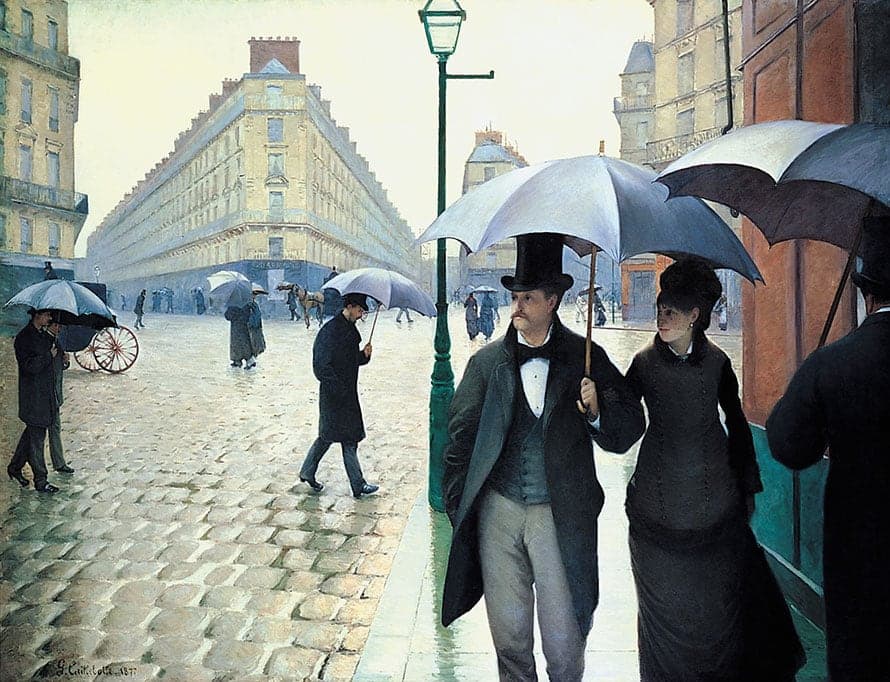
Either Rue DE Paris, temps DE pluie, 1877, a canvas with exceptional dimensions (212 x 276 cm). A wide crossroads where the torino street and the Moscow street intersect. A grey light, reflected in wet cobblestones. A life-size couple is directed at the viewer, with such a determined movement that the viewer would almost tend to retreat. Isolated characters walk around like automatons. A disproportionately large space, such that the eye could only grasp in the wide-angle lens of a camera, creates a feeling of emptiness and psychological emptiness. The gaze wanders without being able to fix itself definitively. The explicit strangeness of this image is explained by the tension between the absurd choreography of the characters' ballet and the geometric ordering of the composition.
The city of Caillebotte is not a space saturated with communications but an empty space where strangers evolve to each other. The precision of the rendering is almost that of an abstract composition. The importance given in the preparatory drawings to the architectural framework, to the perspective, meticulously executed with a rule, to the sketches of characters and details, excludes any idea of chance, of spontaneous creation.
The city of the most Parisian of the impressionists is thus more reminiscent of the ideal city of Piero Della Francesca (15th century), an austere, grid and almost depopulated space, than that of auguste Renoir, Claude Monet or Camille Pissarro. His images take on the appearance of a theatrical setting, where man becomes the simple point of reference of a methodical spatial organization. The silence, the suspended time, the immobilization of the characters, everything recalls the moment before a performance. But at Caillebotte, the performance does not take place.
It is not simply intended to faithfully reproduce visual impressions. The image he proposes contrasts with the period of impressionist spontaneity. Far from trying to capture the time that passes, the atmospheric snapshot, the ephemeral sensation, the mobility of beings, Caillebotte reveals the artifice that lies at the base of any representation. The strangeness of the street spectacle, the rarity of the characters, the distancing effects - the viewer seems separated from the urban space by a glass that stifles rumors - immediately suggest that the painter's real stake lies elsewhere. More than the subject, it is the staging that matters. The elements of the composition become protagonists in their own right, in these canvases that strike with their often incongruous structure. The violence of perspective, the refusal to unify the pictorial field, the contradictory tension between the near and the far, the confusing points of view make all the modernity of the work.
Caillebotte wonders not about what we look at but about how we look, about the conditions of visibility. The titles he gave to these paintings are quite eloquent. The descriptive, "topographical" titles - Boulevard des Capucines, Boulevard Montmartre, Rue Montorgueil or Place Clichy - frequent among his peers, become Rue halevy, seen from a sixth floor, Boulevard seen from above, Homme au balcon or au balcon tout court.
The presence of the gaze in Caillebotte's work is systematic. His characters, passers-by, strollers, men standing at the threshold of a window or on a balcony, are all absorbed in the spectacle of the urban landscape.
The artist constantly seeks to question all quiet enjoyment, by denying our eyes a passive access to the field of representation. Explicitly showing the visual activity displayed by the painter and the amateur in front of the painting thus introduces a disorder in our spectator habits.
One of the first paintings of this type, Jeune homme a la fenetre, dates from 1876. A man seen from his back, slightly turned to the right, observes an almost deserted street from a window. Placed in an interior, this character is protected from emptiness by a stone balustrade. The feeling of vertigo, common in other graillebotte paintings, is avoided here. Yet the viewer remains on an impression of strangeness. Taking up a common theme among romantics, the open window, this painting plays on the "montage" between the first and the third shots to produce an unprecedented effect. Caillebotte USES a composition mode where the foreground and the background seem to collide. The magnification of the foreground is so great, the bottom of the canvas is so exaggerated reduced (the silhouette of the woman on the edge of the pavement is tiny), the shortcut effect is such that the space, whose distances seem disproportionate, becomes unreal.
In a world where women are confined to the "interiors", it is the men who look at the balconies, the vogue of the latter dating from the haussmannian period. These cornice balconies allow stunning views of the Parisian street. The panoramas painted by Caillebotte are distant visions that exclude any intervention of the painter/spectator, place him outside the scene represented.
The distancing effect, characteristic of his paintings, is due to a marked separation between the pictorial field and the viewer. The vision is often misguided: we have one point of view above another point of view. The gaze does not penetrate directly into the space of the representation, it is relayed by that of a character in the foreground, whose only activity is to observe. In other words, it is always a look at the look.
Seen from near or far, Caillebotte's urban landscape is always intriguing. The vision is here more complex, less natural than that of the impressionists. The look remains that of a bourgeois, contemplating the neighborhoods of his class. However, this city is not the idyllic place described by Monet or Renoir.
In the latter, the boulevards are large breakthroughs into which the viewer is invited to enter. Embellished, the city presents itself as a world without conflict, unified and coherent. The impressionists' deep faith in progress, their positivist vision, allows them to give a perfectly optimistic image of urban space. These "pioneers of modernity", the first to serenely represent scenes from contemporary life, are probably also the last to believe in a smooth evolution.
Unlike Degas or Manet, Caillebotte is, history has shown us, more lucid. The collision and heterogeneity of the city's Spaces, the impossibility of giving a unified image, the feeling of vertigo contradict the apparent regularity of the urban order. His work makes it possible to perceive the still discreet signs of what may appear to be the inhumanity of modern metropolises. The melancholy character of his paintings indicates that the modernity of the haussmann city is already perceived with a nostalgic look.